
Canadian Seeding Intentions
- Tuesday April 28, 2009
This analysis featured in the April 28, 2009 issue of the HGCA's MI Prospects, Volume 11, Issue 21
Canadian seeding intentions show an increase in spring wheat and field pea sowings of 6 and 5%, respectively while the area planted to durum wheat, canola and oats is estimated 5,7 and 9% lower compared to 2008. Summer fallow is down 1%.
Statistics Canada Seeding Intentions Survey conducted in late March indicated that Canadian farmers planned to sow 26.7Mha, which would be 1% above last year's intended area. While the total wheat area is up less than 1%, spring wheat sowings are almost 6% higher, at 7.0Mha. Durum and winter wheat sowings are down 5 and 20% at 2.3Mha and 0.9Mha, respectively (Table 1).
continue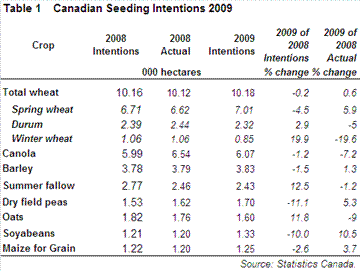
Canola seeding intentions are more than 7% lower at 6.1Mha. Canadian farmers plan to sow a record of 1.7Mha of field peas. The opportunity to extend canola rotations and reduce costs is likely to attract farmers to the latter crop. Barley area intentions, at 3.8Mha, are up more than 1% but the oats area is down 9%. Barley supplies are still relatively tight, but US demand for Canadian oats has not kept pace with increased Canadian output, which is resulting in higher ending stocks.
Maize and soyabean areas, mainly grown in eastern Canada, are estimated at 1.23M and 1.33Mha, up 4 and 11%, respectively. These increases are mainly at the expenses of winter wheat which was the crop of choice rather briefly in autumn 2007.
Summer fallow was traditionally used by Prairie farmers to reduce weed burden, conserve moisture and to some degree to cumulate fertility. Glyphosate resistant canola varieties, minimum tillage and air seeding have reduced the importance of these three purposes and as a result, intentional practice of summer fallowing has also declined. It is now generally limited to the drier areas of the prairies. There is, however, involuntary summer fallowing in some years which would be the result of soil conditions being too wet over an extended period preventing sowing. The practice of summer fallowing has fallen to 30% of what it was 25 years ago.
continue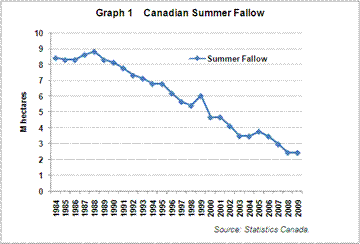
Only soil moisture considerations are now of much influence. The decision that Prairie farmers have to make is whether to risk the costs of sowing a crop knowing soil moisture conditions. Last year the risks were not any higher than usual but the reward in the context of market prices were great. Hence, the rather dramatic 18% decline in summer fallowing occurred for harvest 2008. For harvest 2009 summer fallowing intentions would result in the lowest summer fallowing area since 1916.
It has been another relatively cool and late spring on the Prairies and field work is probably about a week to ten days behind normal. But it is too early to speculate on the implications of significant delays in sowing, which could favour other crops at the expense of wheat.
David Walker (001) 780 434 7615
top of page